The Beach Ecosystem – Heylhi
Coastal Vegetation
Edhuru Veshi Moments
June 2026 Week 1
Previous Weeks
Previous Weeks
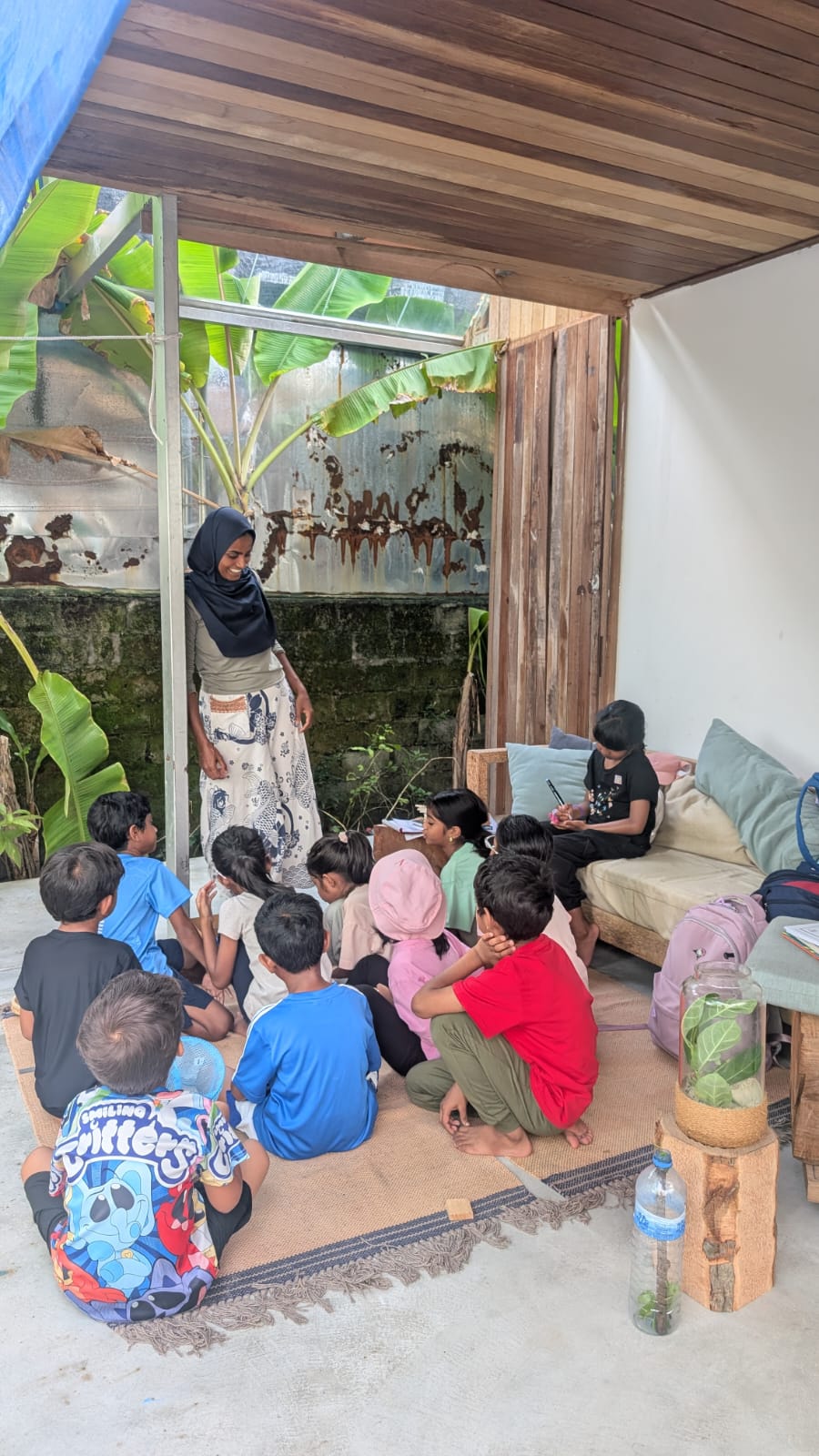
As Miaheli Nakaiy arrives, bringing continuous strong westerly winds and heavy rainfall, the Hulhangu monsoon continues to shape our days. Building on last month’s exploration of sand secrets, our EdhuruVeshi journey now moves from the open shoreline into the island's protective green border: the Heylhi (coastal vegetation zone). This week at MoodhuFilaa, we embraced the changing weather as a teacher rather than an obstacle; our children are learning to navigate their environment with a blend of scientific curiosity and traditional wisdom.
Daily Weather Observation - Arrival of Miaheli
The children are continuing to use their established daily routines to track how the changing season alters the environment around them.
- The Experience: The children reflected on how much the environment has transformed since our early sessions during Reyva Nakaiy, when the days were hot and dry without any rain. Now, with the arrival of Miaheli, they navigate frequent heavy downpours and strong winds. The children are also applying their long-term observations to realize that a low tide means the boat sits lower (requiring less steps to climb), while a high tide brings the boat higher (requiring more steps).
- Learning Goal: To contrast distinct seasonal phases within the Maldivian Nakaiy system and use continuous numerical counting to track physical changes in tidal heights.
- Curriculum Link: Mathematics - Strand 1: Counting and Number Sense : Aligns with the outcome Learning to estimate and solve problems using numbers. Children practice active Counting Skills in a real-world setting by counting physical steps while navigating a changing environment.Environment, Science, and Technology - Strand 2: Earth and Space: Connects to the outcome To know the two seasons that occur in the Maldives, understand the daily weather changes, and recognize the patterns of the monsoon seasons. Children contrast the calm Reyva period with the active winds and rain of Miaheli.
Mapping the Heylhi: Locating Our Island Guardian
Our exploration this month moved from the open shoreline into the island's protective green border: the Heylhi (coastal vegetation zone).
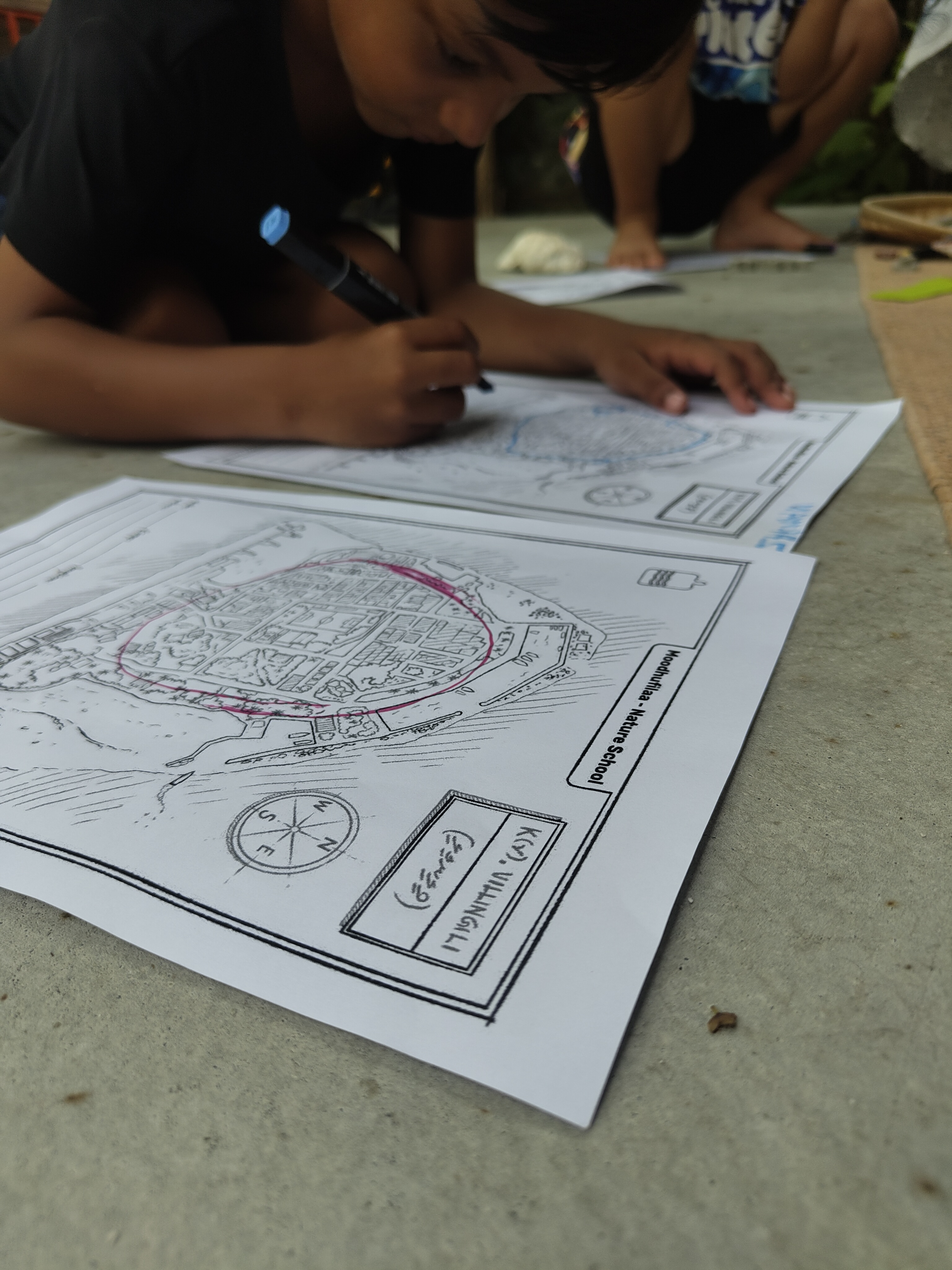
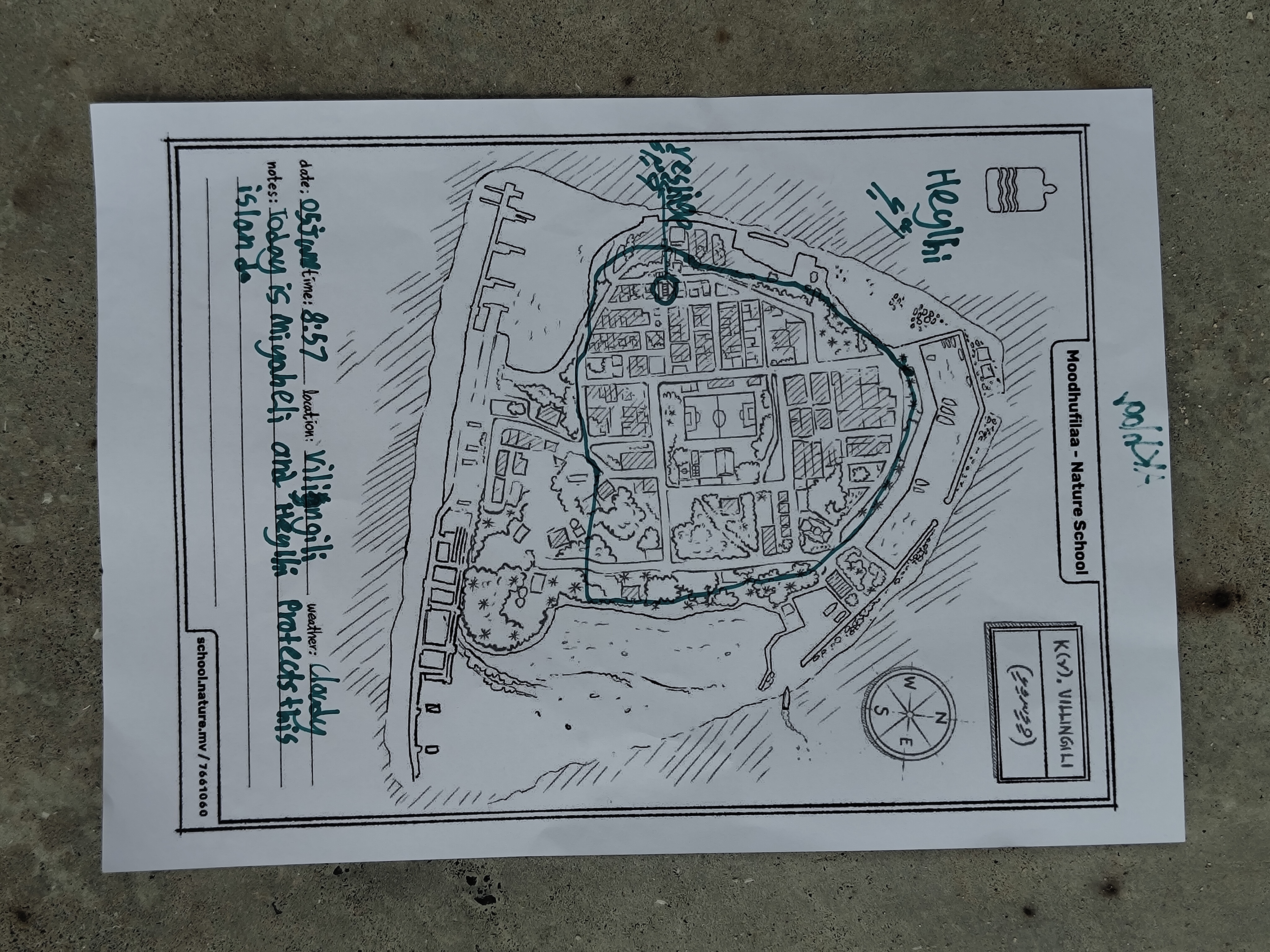
- The Experience: Working with physical maps of the island, the children first oriented themselves by locating Veshige (our school base). From there, they traced and marked the thick green band of coastal vegetation encircling the island. Through this spatial activity, they introduced the term Heylhi—the complete ring of coastal plants—and discussed how this vegetation serves as a natural guard protecting the inner island from harsh monsoonal elements.
- Learning Goal: : To identify the geographic layout of the island, recognize boundaries using maps, and define the environmental purpose of the Heylhifah.
- Curriculum Link: Social Studies — Strand 2: People, Places, and Environment: .Aligns with the outcome Being able to identify and describe people, objects, and places in one's immediate surroundings. Children practice looking at a map to identify water and land areas, locating important places like Veshige and the beach, and demonstrating actions to protect the environment Creative Arts — Strand 1: Visual Arts: Aligns with the outcome Beginning to see creativity and presentation skills. Children use maps to explore common flat shapes and form patterns from the living environment, design layouts, and use symbolic visual lines to represent the coastal forest boundaries.
The Heylhi Challenge: Zonal Foraging
We designed an interactive game to help the children decode the complex layers of the coastal forest through active exploration.
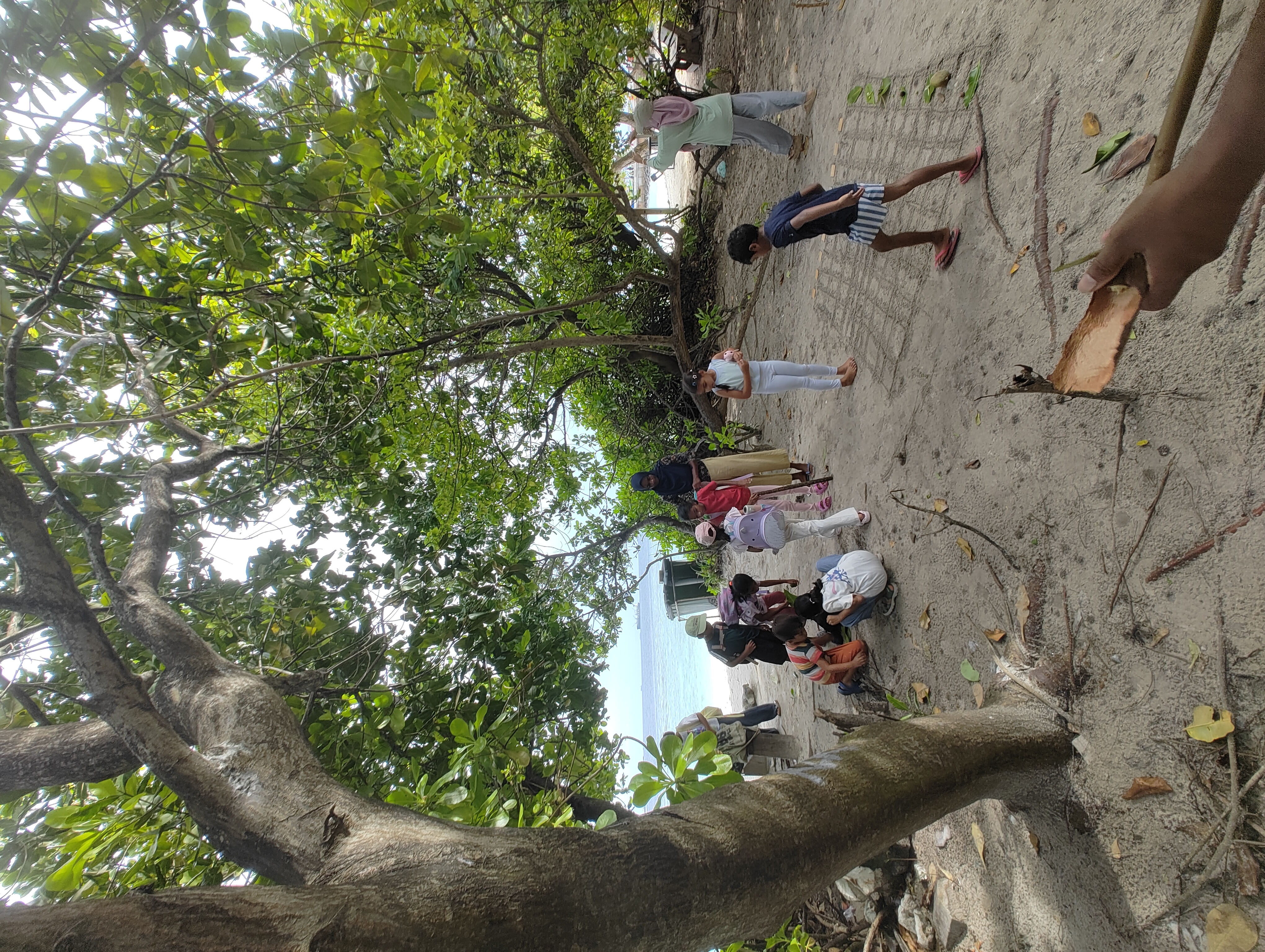
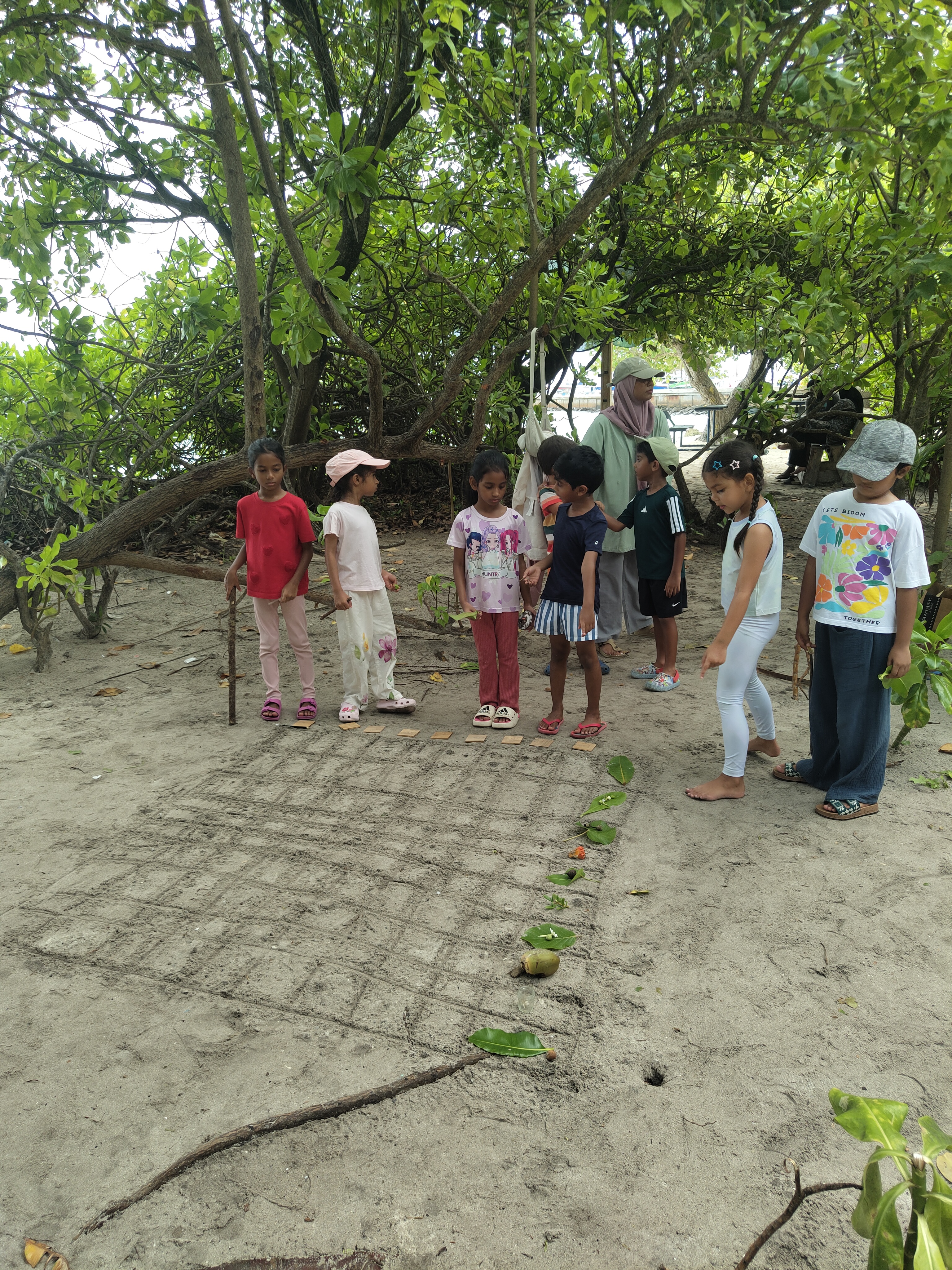
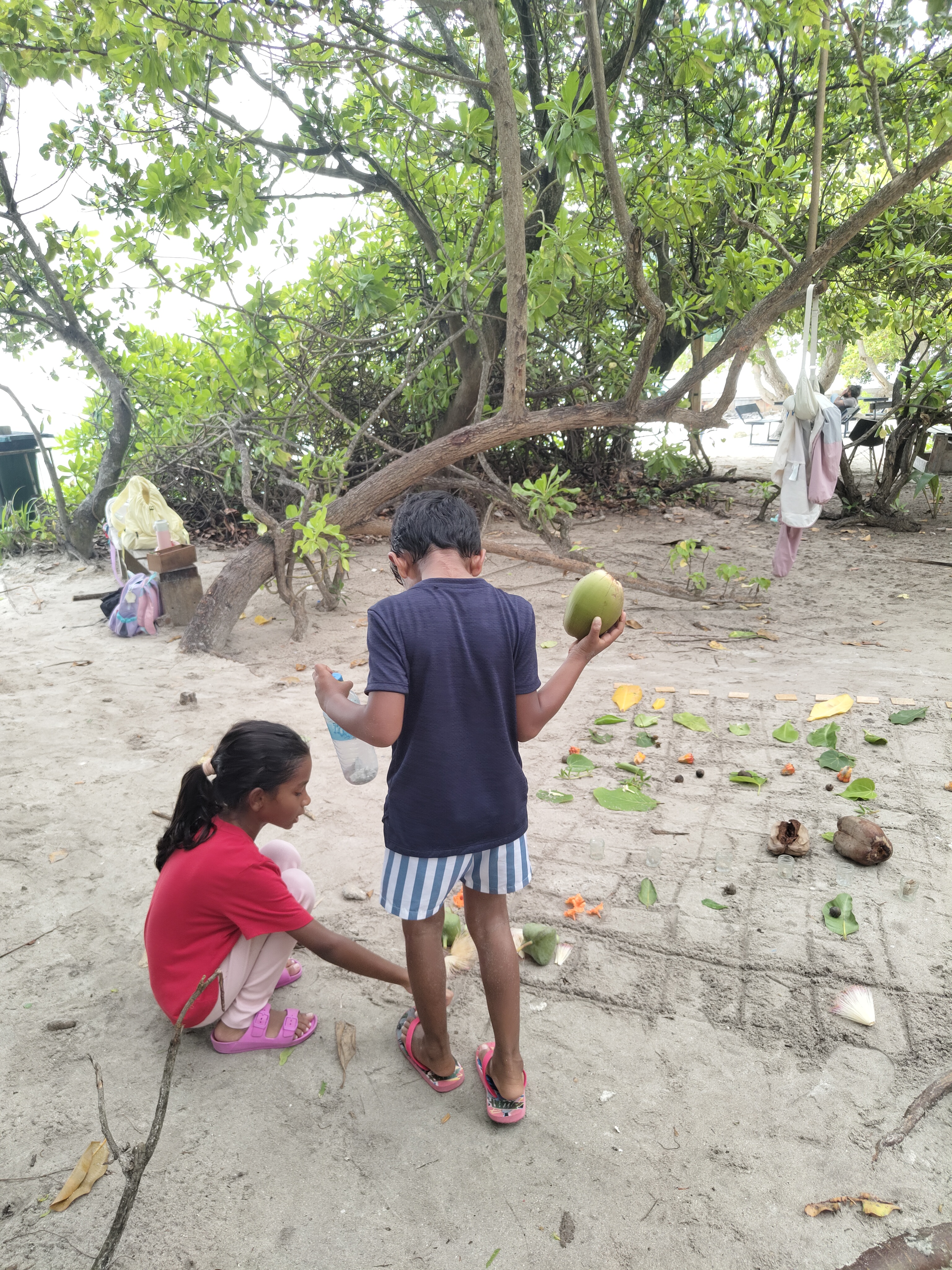
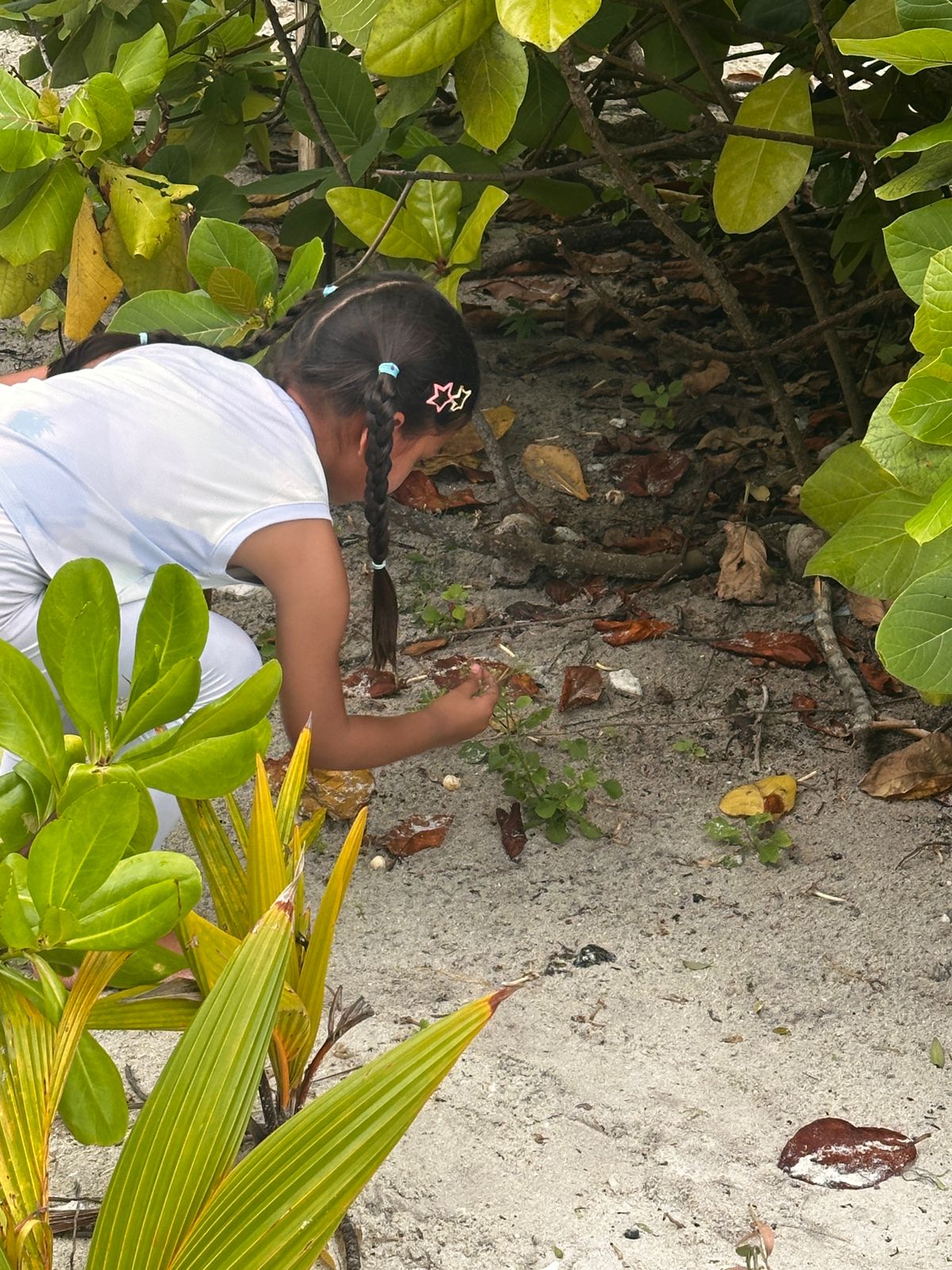
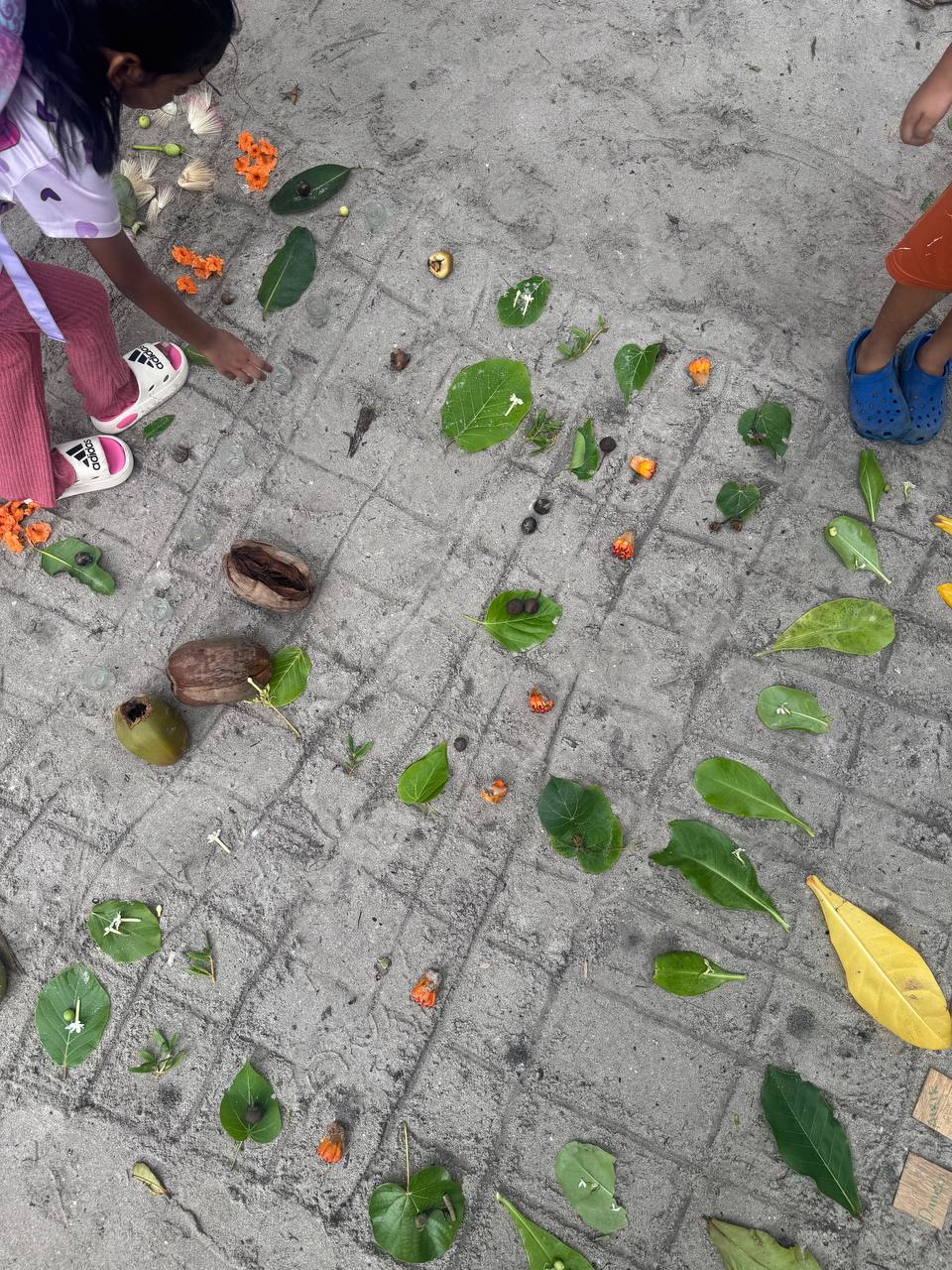
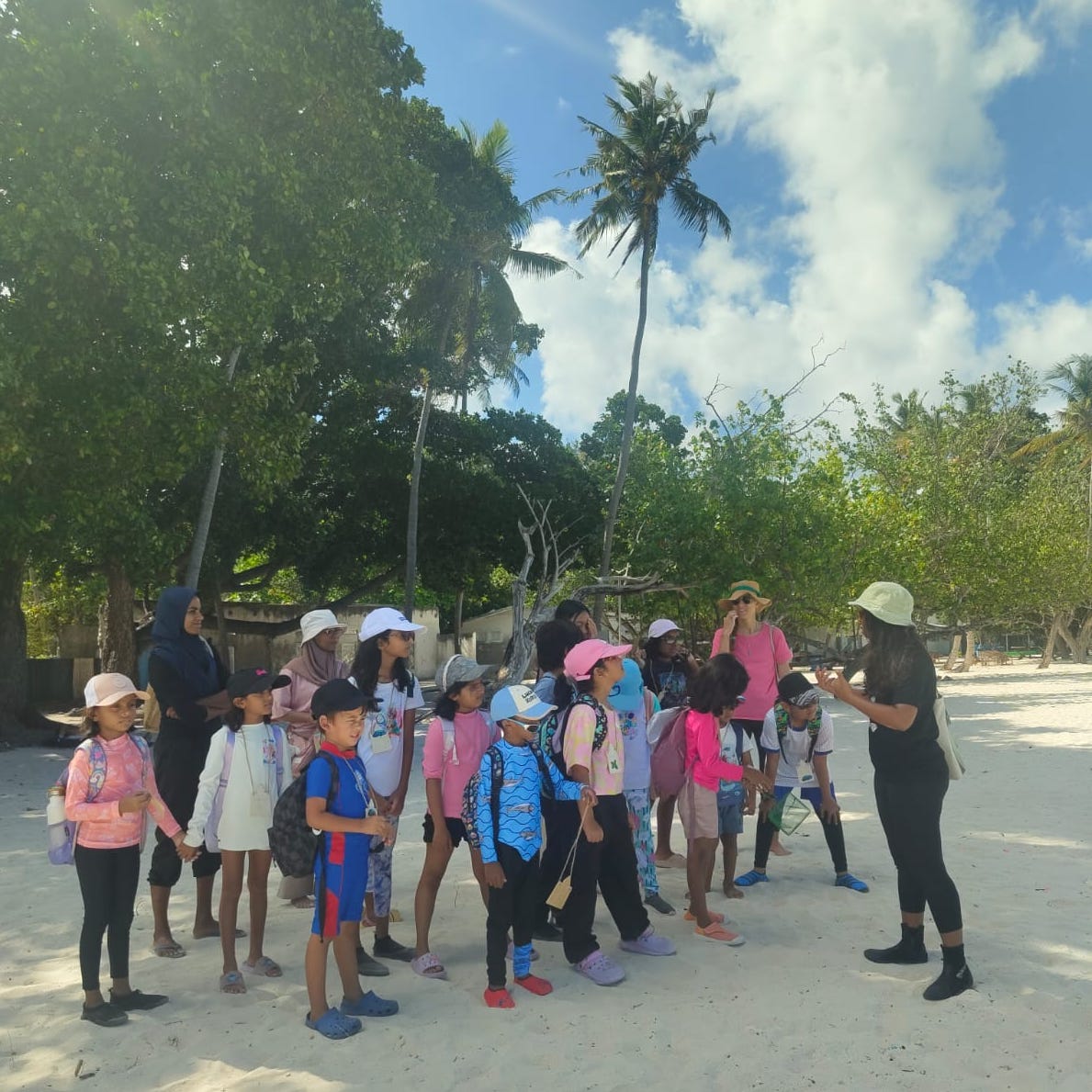
- The Experience: On a large schematic table drawn directly into the beach sand, we displayed a variety of natural elements foraged from the coastal vegetation, including Magoo, Midhii, Hirundhu, Dhiggaa, coconuts, and hermit crabs. The children were challenged to identify these items by their local names and then set off to locate them. Through this game, they discovered that the Heylhi has distinct zones: tough plants like Magoo live on the outer edge facing the salt spray, while coconut palms grow safely inside the interior.
- Learning Goal: To identify local coastal flora and fauna by their traditional names, classify them by their physical traits, and understand their specific habitats.
- Curriculum Link: Environment, Science, and Technology — Strand 1: Life and Growth: Aligns with the outcome Understanding the Classification of Living Things and Their Relationships. Children meet this indicator by identifying and describing different living organisms through investigation (comparing local plants like Magoo, Hirundhu, and Dhiggaa). Social Studies — Strand 2: People, Places, and Environment: Connects to the indicator Identifying and stating living things visible in the surrounding environment (common animals, plants, and creatures) through a hands-on forage.Health and Wellness — Strand 4: Physical Wellness: Aligns with the outcome Knowing and experiencing the basic movements and skills needed for physical activity. Children actively practice locomotor movements to go from one place to another across uneven coastal terrains while participating in sand games and activities. .
Embracing the Elements
Rainwater Potions and Baby Frogs
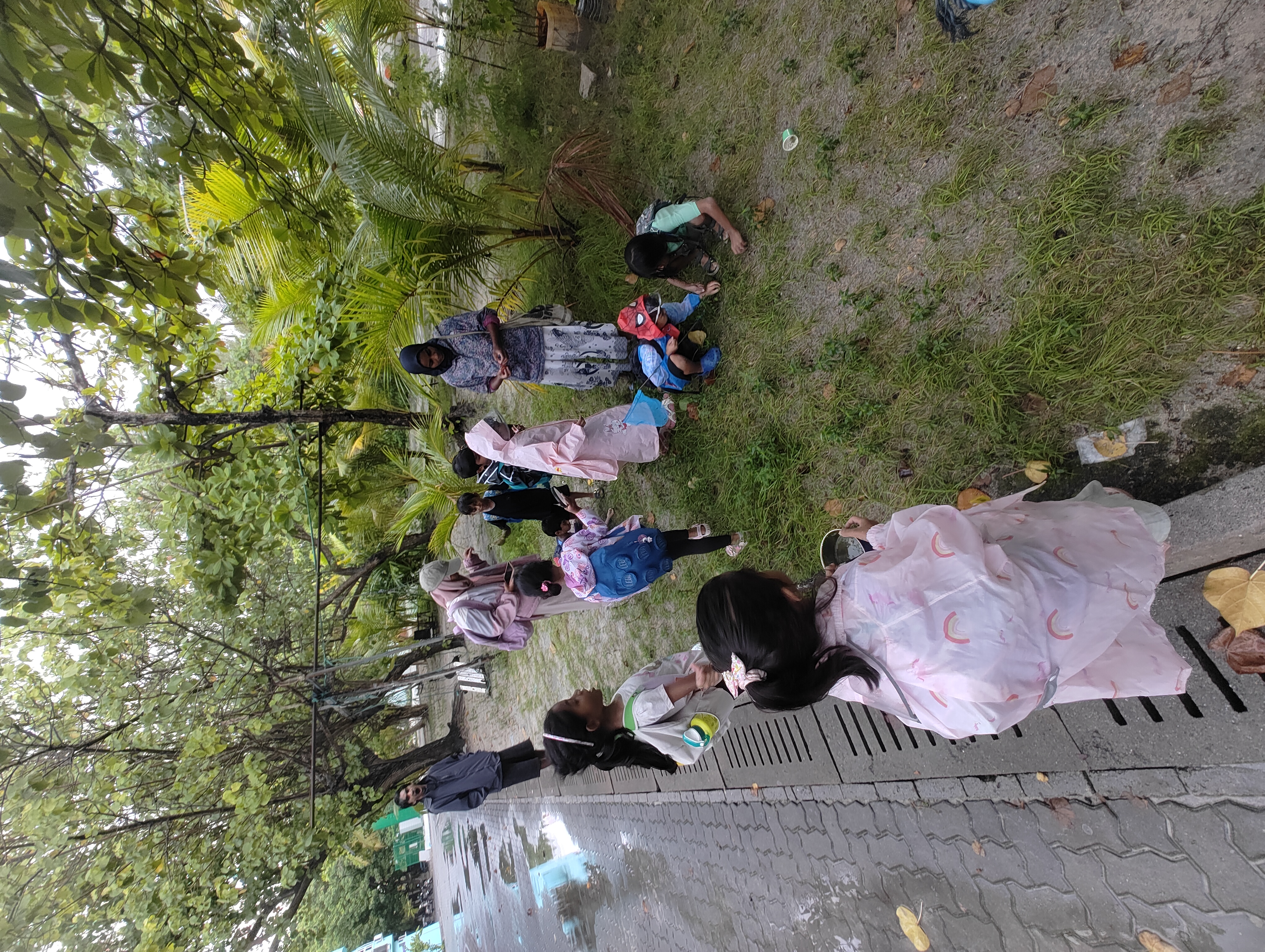
With the heavy downpours of the Miaheli Nakaiy, we leaned into a core philosophy of Nature School: weather is a natural cycle to be embraced and celebrated through creative play.
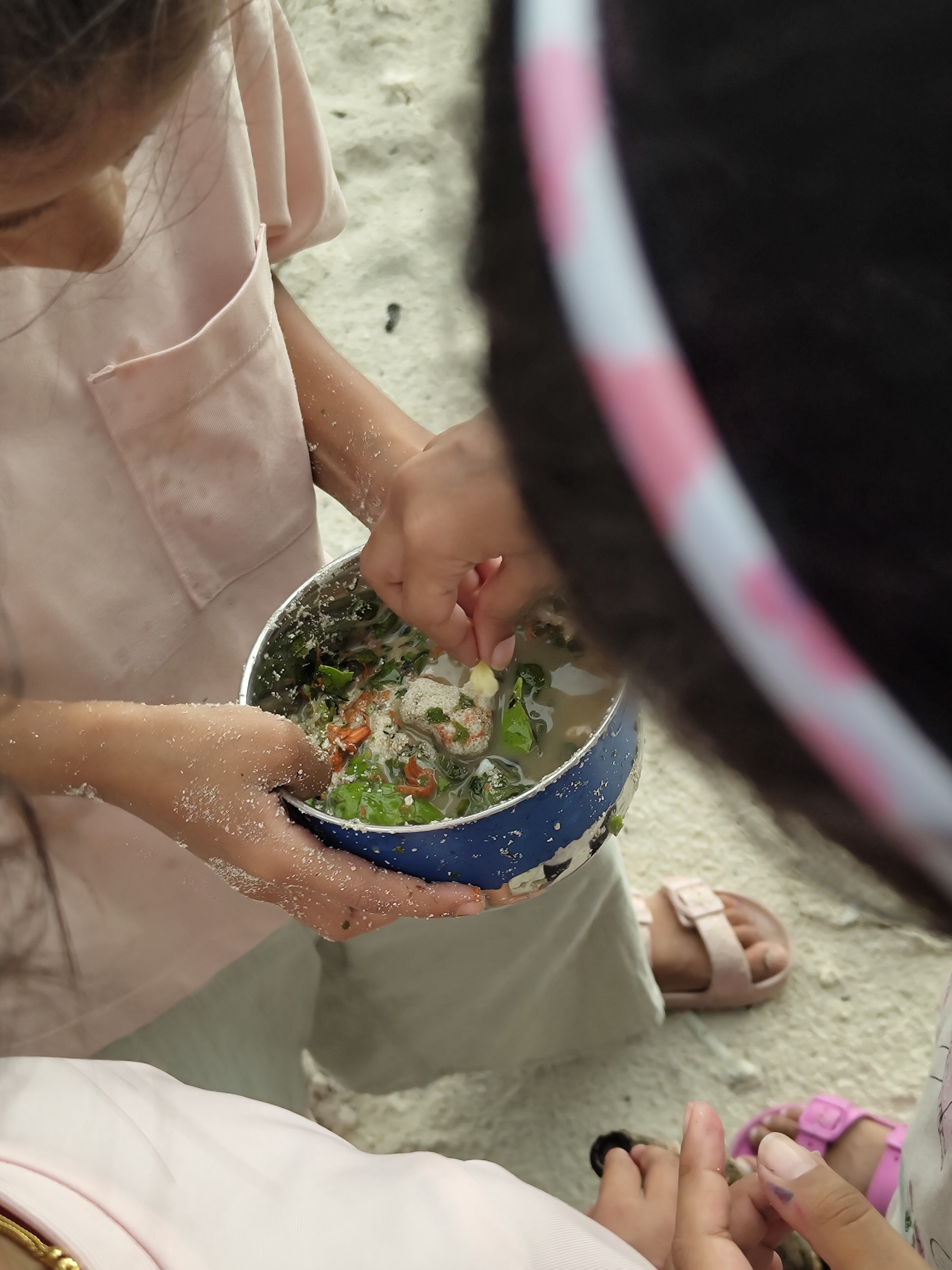
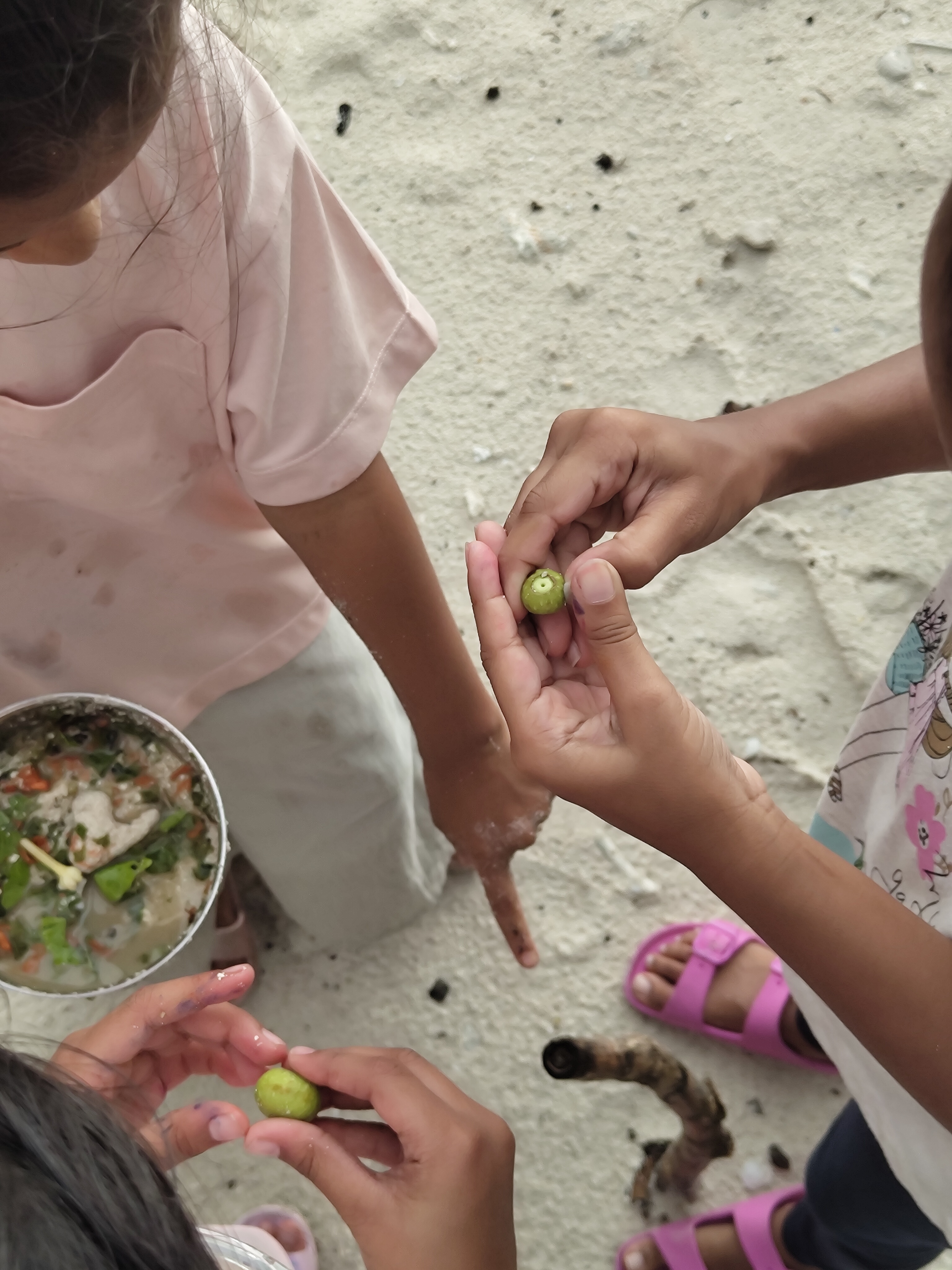
- The Experience: Rather than retreating indoors when it rained, the children gathered at Veshige and stepped out to welcome the downpour. They actively collected fresh rainwater in containers, using it to mix outdoor "nature potions" with sand and leaves. The children also made an exciting discovery in the rain; it brought out tiny baby frogs! They paused their potion-making to gently observe these miniature amphibians hopping through the damp surroundings, marveling at how the rain triggers new life on the island.
- Learning Goal: To build emotional resilience during stormy weather, understand water as a natural resource, and observe how local wildlife responds to monsoonal rainfall.
- Curriculum Link: Health and Wellness — Strand 3: Individual and Community Wellness: Aligns with the indicator Discussing and demonstrating the importance of protection from strong winds, rain, and sun, what can be done for protection, and the items that can be used. Children learn to navigate wet weather confidently using rain gear.Environment, Science, and Technology — Strand 1: Life and Growth: Aligns with the outcome Understanding the Classification of Living Things and Their Relationships. Children meet the indicator When able to identify and describe the young and small varieties of species, directly observing the behavior of the newly emerged baby frogs.Health and Wellness — Strand 4: Physical Wellness: Connects to the indicator Repeatedly demonstrating activities such as pouring, draining, and emptying water into different containers as they measure rain for their potions.
Nature Journaling
Capturing Natural Prompts
Continuous exposure to the changing monsoon environment naturally inspires children to document their discoveries, turning real-world experiences into organic prompts for writing and drawing.
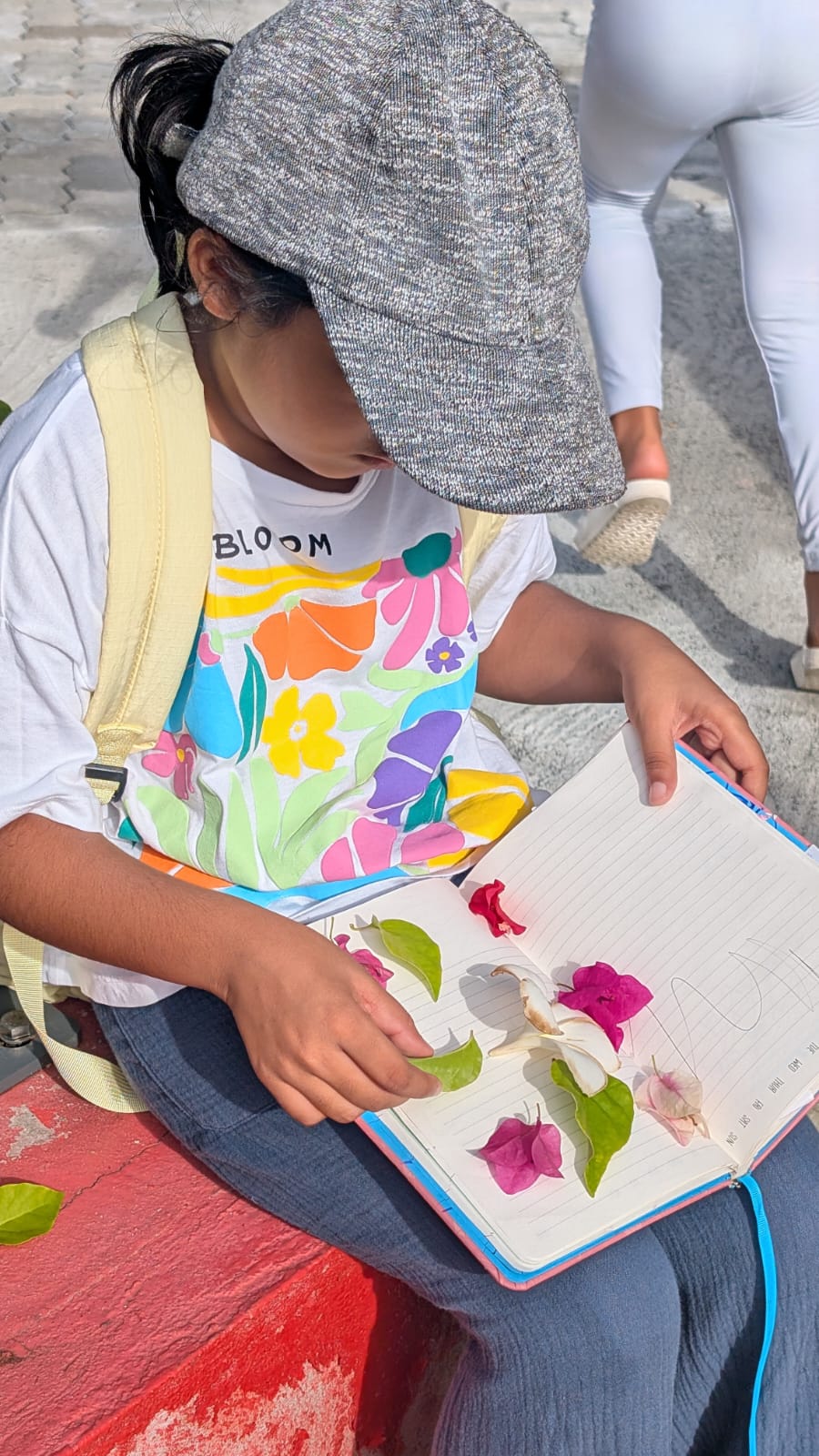
- The Experience: Sitting safely at Veshige while watching the rain, the children opened their nature journals to express their recent observations. They leaned on their immediate surroundings for inspiration: drawing detailed illustrations of the caterpillars they encountered in the foliage, writing out creative "recipes" for their rainwater nature potions, and translating their thoughts about the stormy Miaheli? weather into symbols and letters.
- Learning Goal: To use the natural world as a catalyst for self-expression, practicing fine motor control, inventive spelling, and reflective thought through independent documentation.
- Curriculum Link: English Language — Strand 3: Writing & Representing: Aligns perfectly with the outcome Communicate thoughts, feelings, and experiences using a combination of drawings, symbols, words or sentences. Children meet these exact indicators by writing and representing on self-selected topics (potion recipes, captions) and using drawings to show their experiences with island wildlife like caterpillars. Creative Arts — Strand 1: Visual Arts: Aligns with the indicator Creating pictures or objects based on children's personal experiences and interests, as well as using feelings and imaginative thinking as they translate their coastal observations onto the journal pages.
Cognitive Development: Nature and Enhanced Creativity
At MoodhuFilaa Nature School, we utilize the outdoors as a primary catalyst for imaginative thought and cognitive growth.
Unstructured play in nature's classroom, with its endless supply of sand, shells, leaves, and other loose parts, ignites a child's natural creativity. Unlike synthetic toys with pre-determined formats, these open-ended natural materials have no single "correct" purpose; a single piece of shell can become a spoon for mixing rainwater potions, a precise stylus for tracing letters in the sand, or a decorative element on an island map. This fluidity encourages our children to invent, experiment, and think freely, allowing them to solve problems resourcefully and design their own learning spaces. By turning the beach into a living laboratory for creative risk-taking, our students develop the fluid intelligence, cognitive flexibility, and independent thinking skills needed for lifelong learning.

EDHURU VESHI
Ages 5 to 8
Weekend Nature School
Registration OPEN for NEW Session